
|
1. The standard kilogram (Fig. 1.1a) is a platinum–iridium cylinder 39.0 mm in height and 39.0 mm in diameter. What is the density of the material?
View Detail ... 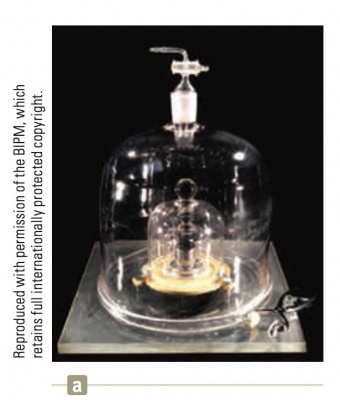 2. A proton, which is the nucleus of a hydrogen atom, can be modeled as a sphere with a diameter of `2.4 fm` and a mass of `1.67 times 10^(-27) kg`.
(a)Determine the density of the proton.
(b) State how your answer to part (a) compares with the density of osmium, given in Table 14.1
View Detail ... 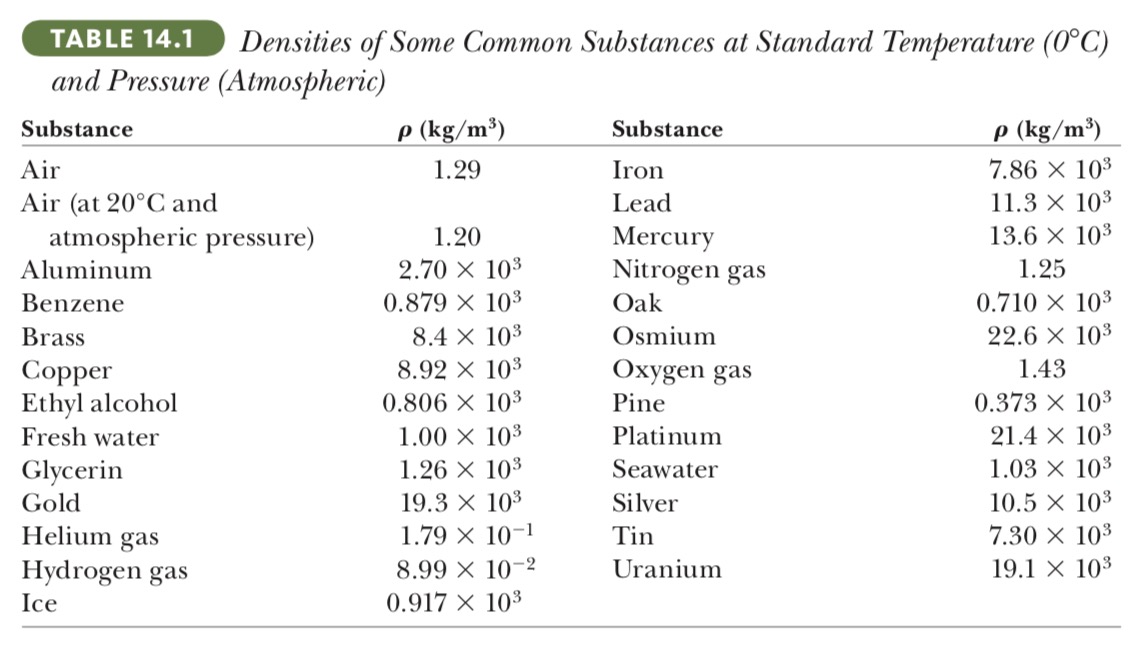 3. Which of the following equations are dimensionally correct?
(a)`v_f = v_i + ax`
(b)`y=(2m)cos(kx)`,where `k=2m^-1`
View Detail ... 4. Kinetic energy `K` has dimensions `kg•m^2//s^2`. It can be written in terms of the momentum `p` and mass `m` as
`K=p^2/(2m)`
(a) Determine the proper units for momentum using dimensional analysis.
(b) The unit of force is the newton N,where `1 N =1kg•m//s^2` .What are the units of momentum `p` in terms of a newton and another fundamental SI unit?
View Detail ... 5. How many significant figures are in the following numbers?
(a) `78.9 +- 0.2`
(b) `3.788 times 10^9`
(c) `2.46 times 10^(-6)`
(d) `0.0053`
View Detail ... 6. A rectangular plate has a length of (`21.3 +- 0.2`) cm and a width of (`9.8 +- 0.1`) cm. Calculate the area of the plate, including its uncertainty.
View Detail ... 7. Carry out the arithmetic operations
(a) the sum of the measured values 756, 37.2, 0.83, and 2;
(b) the product `0.0032 times 356.3`; and
(c) the product `5.620 times pi`.
View Detail ... |